
Eid al-Fitr has a particular salat (Islamic prayer) that consists of two rakats (units) generally performed in an open field or large hall. It may only be performed in congregation (jamāʿat) and features seven additional Takbirs (raising of the hands to the ears while saying “Allāhu ʾAkbar”, meaning “God is the greatest”) in the Hanafi school of Sunni Islam: three at the start of the first rakat and three just before rukūʿ in the second rakat.[7] Other Sunni schools usually have 12 Takbirs, similarly split in groups of seven and five. In Shia Islam, the salat has six Takbirs in the first rakat at the end of qira’a, before rukūʿ, and five in the second.[8] Depending on the juristic opinion of the locality, this salat is either farḍ (فرض, obligatory), mustaḥabb (strongly recommended) or mandūb (مندوب, preferable). After the salat, Muslims celebrate the Eid al-Fitr in various ways[9] with food (“Eid cuisine“) being a central theme, which also gives the holiday the nickname “Sweet Eid” or “Sugar Feast”.[10][11]

According to Muslim tradition, Eid al-Fitr was originated by the Islamic prophet Muhammad.[12] According to certain traditions, these festivals were initiated in Medina after the migration of Muhammad from Mecca. Anas, a well-known companion of the Islamic prophet, narrated that, when Muhammad arrived in Medina, he found people celebrating two specific days in which they entertained themselves with recreation and merriment. At this, Muhammad remarked that God had fixed two mandatory days of festivity: Eid al-Fitr and Eid al-Adha.[13]
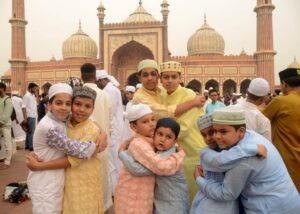
Eid al-Fitr begins at sunset on the night of the first sighting of the crescent moon. The night on which the moon is sighted is celebrated as Chand Raat. If the moon is not observed immediately after the 29th day of the previous lunar month (either because clouds block its view or because the western sky is still too bright when the moon sets), then the holiday is celebrated the following day.[14] Eid al-Fitr is celebrated for one to three days, depending on the country.[15] It is forbidden to fast on the Day of Eid, and a specific prayer is nominated for this day.[16] As an obligatory act of charity, money is paid to the poor and the needy (Zakat-ul-fitr) before performing the ‘Eid prayer.[17]
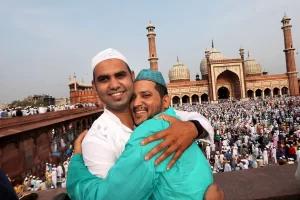
So as a Muslim we are , we should observed this day with love . Otherwise we can not realize the happiness of this day.. Thanks
Md.Elias – Bin – Sikander
DM-207