Operation Midnight Hammer: A Landmark Strike on Iran’s Nuclear Infrastructure
Introduction:
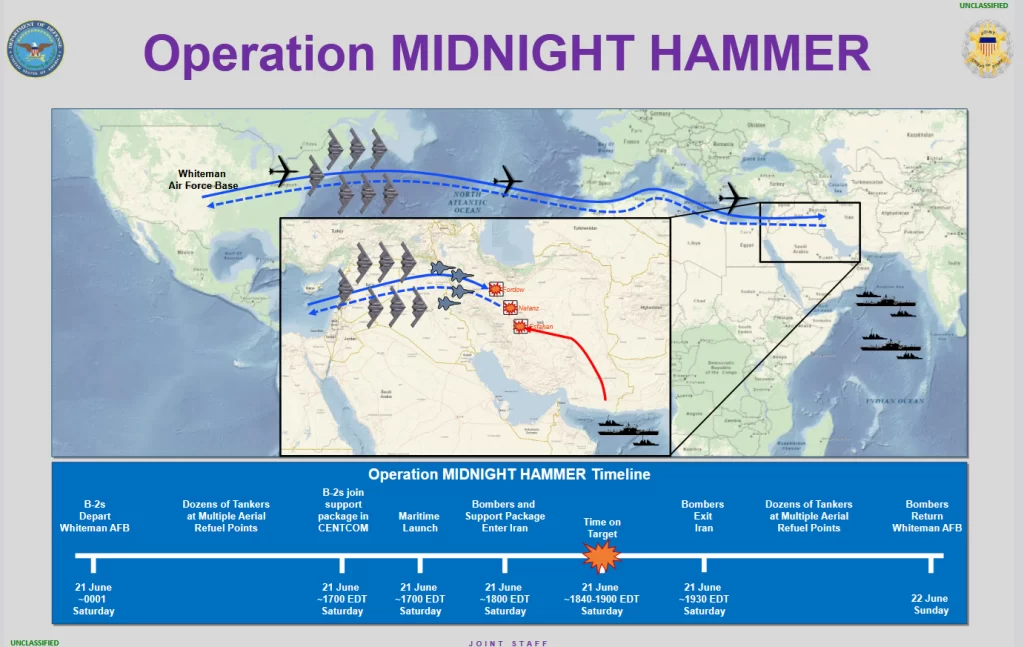
Operation Midnight Hammer was executed on June 22, 2025, orchestrated by the U.S. under President Trump. Specifically, the mission targeted Iran’s fortified nuclear facilities—Fordow, Natanz, and Isfahan—using advanced bunker-buster technology in a highly coordinated.
In addition, the attack represented the first-ever use of the 30,000‑lb GBU‑57A/B MOP in combat. A squadron of seven B‑2 Spirit stealth bombers—backed by tanker aircraft, drone and decoy coverage, and ISR support—carried out the strikes. Consequently, 14 MOPs were dropped within a 25-minute window, culminating with submarine-launched Tomahawks to ensure full mission success.
Mission Design & Execution
- To begin with, the operation involved unprecedented scale: 125 aircraft, mid-air refueling, and a deceptive maneuver involving decoy bombers flying toward Guam—all aimed at generating confusion.
- Then, the real strike group flew stealthily from Whiteman AFB in Missouri, conducting continuous flights for approximately 37 hours—the longest B‑2 mission since 2001
- Subsequently, decoy fighter formations shielded the bomber fleet, while suppression of enemy air defenses neutralized any interception risk. Meanwhile, Iran reportedly remained unaware, with no SAMs or fighter responses.
Strategic and Operational Impact
- First, the strike inflicted severe damage on Iran’s nuclear infrastructure—U.S. analysts report major damage at Fordow and Isfahan, while Natanz has been effectively demolished.
- However, early intelligence suggests Iran’s core nuclear capabilities—enriched uranium stockpiles and centrifuge systems—weren’t eradicated, implying only temporary disruption.
- Additionally, U.S. officials portrayed the mission as narrowly focused on nuclear targets, not aimed at regime change or civilian harm. Still, Iran has vowed retaliation .
Implications & Broader Context
Therefore, Operation Midnight Hammer underscored U.S. strategic reach and precision. Similarly, it signaled deterrence—highlighting America’s willingness to use its most advanced weaponry to curb nuclear proliferation.
Meanwhile, this operation integrated deception, stealth, and sub-surface assets, reflecting modern warfare’s edge. Importantly, it reinforced that America can execute global strikes with surgical accuracy while minimizing collateral exposure.
Risks, Reprisal & Regional Fallout
Iranian retaliation could take asymmetrical forms—proxy attacks, cyber warfare, or strikes on U.S. bases in Iraq and Qatar . Additionally, bombings at nuclear sites risk accelerating Iran’s nuclear ambitions, as loss of inspections or heightened resolve may follow.
Furthermore, the legality of such strikes is under legal scrutiny Critics contend the decision lacks proper congressional mandate and potentially infringes on international law.
What Comes Next
- Iranian Reaction
- First, expect potential escalation: asymmetric strikes, proxy responses, or threats to military assets in the region.
- Assessment of Damage
- Secondly, detailed intelligence will determine whether Iran’s nuclear infrastructure can rebound in the coming months.
- Diplomatic Fallout
- Additionally, global pressure may increase for Iran to re-enter nuclear diplomacy, especially via IAEA and European mediators.
- Regional Security
- Furthermore, United States. bases in the Gulf, Iraq, and Syria will likely remain on high alert. Likewise, American forces will continue to prepare for potential counterattacks.
In summary, Operation Midnight Hammer represents a historic milestone: the largest-ever B‑2 strike using top-tier bunker-buster bombs designed to puncture mountain-hard nuclear bunkers. Consequently, while the raid inflicted serious damage, Iran’s recovery capability remains a concern—and vigilance will be essential to prevent further escalation. Nevertheless, the debate continues: whether it achieved lasting impact or merely delayed Iran’s nuclear trajectory—and what retaliation or diplomatic avenues will follow.