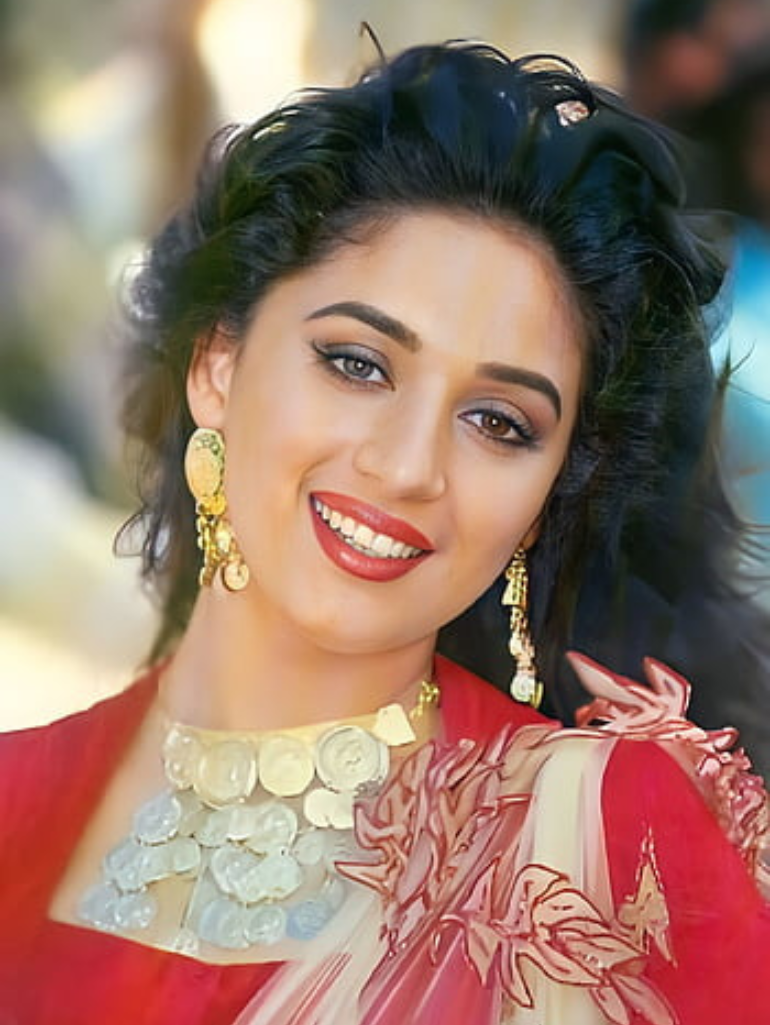
“Madhuri Dixit : Journey through Bollywood Milestones, Iconic Performances, and Dance Expertise in a Versatile Career.”

Born Name : Madhuri Dixit Nene
Born : 15 May 1967 (age 56)
Place : Bombay, Maharashtra, India
Occupations : Actress; Television personality
Years active : 1984–present
Spouse :
Shriram Madhav Nene (Married – 1999)
Children : 2
Honours : Padma Shri (2008)
About

Madhuri Dixit , born on May 15, 1967, hails from a Marathi Kokanastha Brahmin family in Bombay (now Mumbai) to Shankar and Snehlata Dixit. Growing up with two elder sisters and an elder brother, her passion for dance ignited at a tender age of three. She delved into Kathak, dedicating eight years to rigorous training, eventually mastering it professionally.
Her journey in dance bore fruit early on when, at nine, she earned a scholarship as a Kathak dancer. Her initial taste of recognition came at seven or eight during a Guru Purnima festival performance, which caught the attention of a journalist.
His article praising her talent left her ecstatic, instilling in her a sense of accomplishment and self-worth.
Education-wise, Dixit attended Divine Child High School in Andheri. Alongside her studies, she actively engaged in extracurriculars, notably in dramatics. Despite initially aspiring to become a microbiologist, she enrolled at Sathaye College in Vile Parle, Mumbai, pursuing microbiology in her BSc.
However, her ardor for the world of cinema eclipsed her academic path. Just six months into her course, she made the pivotal decision to forgo her studies and wholeheartedly pursue a career in films.
Early life and background

Madhuri Dixit, born on May 15, 1967, grew up in a Marathi Kokanastha Brahmin household in Bombay, now known as Mumbai, to parents Shankar and Snehlata Dixit. With two older sisters and an elder brother, her fascination with dance sparked at the age of three. This passion led her to an eight-year journey mastering Kathak, eventually becoming a proficient Kathak dancer.
Her breakthrough in dance came at nine when she earned a Kathak scholarship. Her first taste of public recognition occurred at a Guru Purnima festival performance when she was seven or eight. A journalist present there wrote an article praising her performance, describing her as stealing the show, which left her elated and fueled her sense of accomplishment and self-worth.
Madhuri pursued her education at Divine Child High School in Andheri. Alongside her academic pursuits, she actively participated in extracurricular activities, notably in dramatics. Initially aiming to become a microbiologist, she enrolled at Sathaye College in Vile Parle, Mumbai, majoring in microbiology as part of her BSc. However, six months into her course, her passion for a full-time career in films overshadowed her academic path, prompting her to discontinue her studies.
Acting career
1980s: Early roles, breakthrough and recognition

Madhuri Dixit embarked on her cinematic journey in 1984 with Rajshri Productions’ “Abodh,” co-starring Tapas Paul.
Despite the film’s commercial setback, Dixit’s portrayal as a naive village girl garnered praise from critics. Her appearance on the cover of Debonair magazine and Filmfare in 1986 marked early moments of recognition.
Throughout 1985 and 1986, her films like “Awara Baap,” “Swati,” “Manav Hatya,” “Hifazat,” and “Uttar Dakshin” failed to make a mark, neither critically nor commercially.
It wasn’t until 1988 that Dixit found success with “Dayavan,” followed by the pivotal role of Mohini in “Tezaab.”
This film emerged as the year’s highest-grossing movie, earning her a Filmfare Award nomination and establishing her as a leading actress in Hindi cinema.

Her ventures in 1989 included “Vardi,” the blockbuster “Ram Lakhan,” and the romantic drama “Prem Pratigyaa,” all contributing to her rising stardom.
“Tridev,” an action thriller, became one of the year’s biggest hits. “Parinda,” a critical and commercial success, showcased her as Paro, earning accolades for her poignant portrayal.
In the same year, her roles in “Ilaaka,” “Mujrim,” “Paap Ka Ant,” and “Kanoon Apna Apna” contributed to her successful streak. While some films resonated with audiences, others landed as average earners.
Madhuri Dixit’s journey in the late ’80s showcased a blend of box office successes, critical acclaim, and a range of characters that underscored her ascent as a versatile and impactful actress in Indian cinema.
1990s: Rise to prominence and widespread success

In 1990, Madhuri Dixit starred in nine films, but only “Kishen Kanhaiya” stood out among movies like “Maha-Sangram,” “Deewana Mujh Sa Nahin,” “Jeevan Ek Sanghursh,” “Sailaab,” and “Jamai Raja.” Her role in “Kishen Kanhaiya,” alongside Anil Kapoor and Shilpa Shirodkar, was a top-earner that year. She showcased her acting finesse in “Izzatdaar,” won her first Filmfare Award for Best Actress for “Dil,” and “Thanedaar” was another commercial success.
In 1991, her standout film was “Saajan,” featuring Dutt and Salman Khan, which was a critical and commercial triumph. Dixit’s portrayal garnered accolades, leading to her fourth Best Actress nomination at Filmfare.
In 1992, Dixit gained recognition for “Beta,” alongside Anil Kapoor, earning her a second Filmfare Award for Best Actress. Other movies like “Zindagi Ek Juaa,” “Prem Deewane,” “Khel,” and “Sangeet” added diversity to her repertoire.

Her roles in 1993 in films like “Sahibaan” and “Khalnayak” showcased her versatility. “Khalnayak” earned her critical acclaim for portraying a determined police officer.
In 1994, Dixit starred in “Anjaam” alongside Shah Rukh Khan and in the blockbuster “Hum Aapke Hain Koun..!” opposite Salman Khan. Her performance in both movies received acclaim, with “Hum Aapke Hain Koun..!” becoming a historic success.
Continuing her successful streak in 1995, Dixit starred in “Raja” and “Yaraana.” “Raja” emerged as one of the top-grossing films of the year, while “Yaraana” fell short of expectations.
In 1997, her performance in “Mrityudand” earned critical acclaim, portraying a woman challenging societal oppression. The same year, she starred in the musical blockbuster “Dil To Pagal Hai” alongside Shah Rukh Khan and Karisma Kapoor, earning her a fourth Filmfare Award for Best Actress.
In 1998, Dixit showcased her versatility in “Wajood” and made a cameo appearance in “Bade Miyan Chote Miyan.” Her only film in 1999, “Aarzoo,” unfortunately didn’t fare well commercially.
2000s: Further acclaim and sabbaticals

In 2000, Madhuri Dixit starred in “Pukar” opposite Anil Kapoor, portraying Anjali, a scorned lover seeking vengeance. Her role garnered nominations for Best Actress at various award ceremonies.
The film, revolving around a love story in the Indian Army, received positive reviews but was an average grosser. Dixit’s other project that year, “Gaja Gamini,” directed by M.F. Husain, depicted the titular character in various incarnations like Mona Lisa and Shakuntala. However, the film underperformed at the box office.
The following year, Dixit appeared in “Yeh Raaste Hain Pyaar Ke,” a love triangle featuring Ajay Devgan and Preity Zinta, which received negative reviews and failed commercially. In “Lajja,” a social drama directed by Rajkumar Santoshi, she played Janki, a theater actress facing social stigmas.

Despite being unsuccessful in India, the film found success overseas. Dixit earned acclaim for her performance, receiving a nomination for Best Supporting Actress at Filmfare and winning the Zee Cine Award for Best Supporting Actor – Female.
In 2002, Dixit starred in “Hum Tumhare Hain Sanam,” a love triangle with Shah Rukh Kha
n and Salman Khan. Though delayed in production, the film had moderate success in India. Her significant project that year was “Devdas,” directed by Sanjay Leela Bhansali, where she portrayed Chandramukhi, a courtesan.
Dixit’s performance was highly praised, earning her the Filmfare Award for Best Supporting Actress. The film was a commercial success and received global acclaim, being India’s entry for the Academy Awards and earning multiple accolades at the National Film Awards.
After “Devdas,” Dixit took a break from films to focus on her personal life. Her subsequent comeback in 2007 with “Aaja Nachle,” playing Dia, a choreographer striving to save a theater, received positive reviews for her performance, despite the film’s box office failure. Her portrayal earned her another nomination for the Filmfare Award for Best Actress.
2010s: Comebacks and sporadic work

In 2011, Dixit returned to India and received Filmfare’s special jury recognition for her 25 years in Bollywood. She made a cameo in “Yeh Jawaani Hai Deewani” in 2013 and danced with Ranbir Kapoor in the song “Ghagra.”
Her 2014 black comedy “Dedh Ishqiya,” a sequel to “Ishqiya,” showcased her as Begum Para. Critics praised her nuanced performance, earning her a Filmfare nomination. The film received critical acclaim but had a modest box office run.
Following this, Dixit starred in “Gulaab Gang” as Rajjo, inspired by activist Sampat Pal Devi. Though her preparation involved rigorous training, the film faced mixed reviews and performed poorly at the box office.
Four years later, she debuted in Marathi cinema with “Bucket List,” portraying Madhura Sane, which earned her acclaim for her performance and was appreciated for its heartfelt storytelling.

Her reunion with Anil Kapoor and Ajay Devgn in “Total Dhamaal” (2019) garnered mixed reviews, but her chemistry with Kapoor was well-received. Despite criticism, the film emerged as a commercial success.
Additionally, Dixit produced the Marathi film “15 August” under her production company, RnM Moving Pictures, emphasizing freedom in various life aspects.
In “Kalank” (2019), a period romantic drama, Dixit played Bahaar Begum, receiving praise for her standout performance despite the film’s underwhelming box office performance. She earned a Filmfare nomination for Best Supporting Actress.
Finally, in 2022, Dixit took the lead in the Netflix series “The Fame Game,” marking her continued foray into streaming platforms.
Dancing and stage performances
Madhuri Dixit’s stage presence and performances have been expansive, spanning concerts like “Madhuri Dixit Live” across India, the Middle East, and the US. She was part of iconic tours like “Unforgettable World Tour,” “Temptation Reloaded,” “SLAM! The Tour,” and the show Fusion.

Additionally, she launched “Dance With Madhuri,” an online dance academy offering lessons across various dance styles, engaging enthusiasts worldwide.