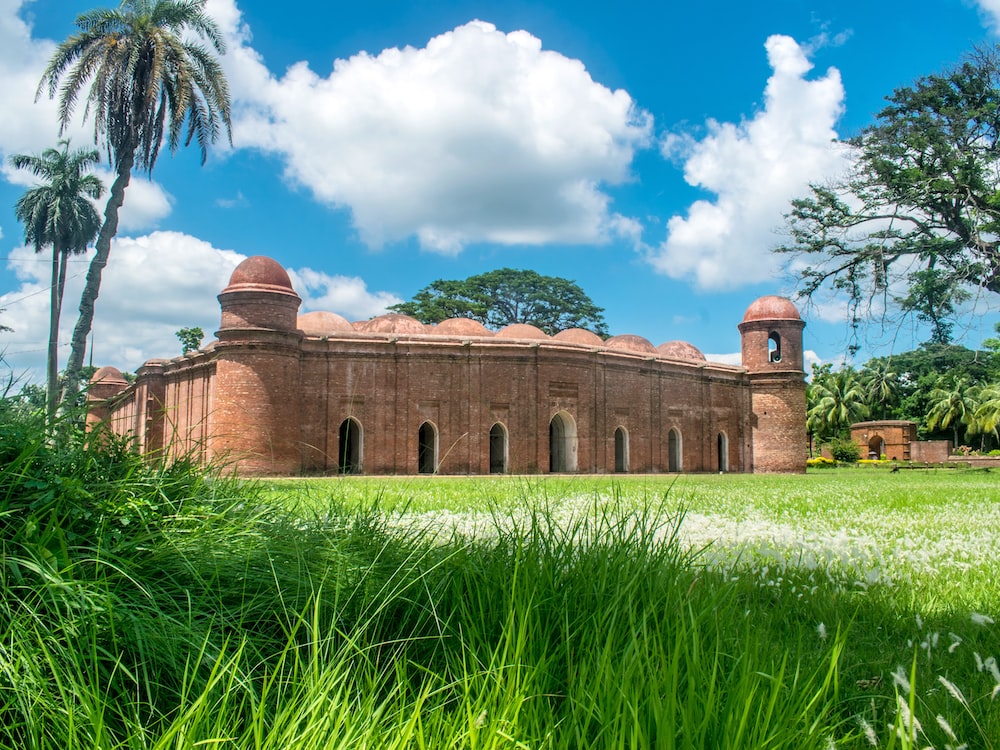
The Sixty Dome Mosque (more commonly known as Shait Gambuj Mosque or Saith Gunbad Masjid), is a mosque in Bangladesh. It is part of the Mosque City of Bagerhat, a UNESCO World Heritage Site. It is the largest mosque in Bangladesh from the sultanate period (1204-1576). It was built during the Bengal Sultanate by Ulugh Khan Jahan, the governor of the Sundarbans. It has been described as “one of the most impressive Muslim monuments in the whole of the Indian subcontinent.
In the middle of the 15th century, a Muslim colony was founded in the mangrove forest of the Sundarbans, near the coast in the Bagerhat District by a saint-General, named Khan Jahan Ali. He preached in an affluent city during the reign of Sultan Nasiruddin Mahmud Shah, then known as ‘Khalifalabad’.Khan Jahan adorned this city with more than a dozen mosques, the ruins of which are focused around the most imposing and largest multi-domed mosques in Bangladesh, known as the Shait-Gumbad Masjid (160’×108′). The construction of the mosque was started in 1442 and it was completed in 1459. The mosque was used for prayers, and also as a madrasha and assembly hall.
see more best historical places of bangladesh
A World Heritage
In the early eighties of the twentieth century, UNESCO declared the six-hundred-year-old sixty dome Mosque a World Heritage Site and also declared the city of Bagerhat as the ‘Historic Mosque City of Bagerhat‘. The reason why the whole city of Bagerhat is recognized as a ‘city of historical mosques’ is that in addition to the Shat Gombuj Mosque, there are many other ancient mosques in Bagerhat. Specifically, a total of 17 historical architectures of Bagerhat have been enlisted on the World Heritage List by UNESCO, ten of which are mosques.
These ancient mosques, including Shat Gombuj, have made Bagerhat one of the three World Heritage Sites in Bangladesh.